- The Journal Entry
- Posts
- How does franchising actually work?
How does franchising actually work?
Insights into the franchising business model for CA(SA) students.

Xavier Prospero
January 20, 2026
How does franchising actually work?
2 Min Read
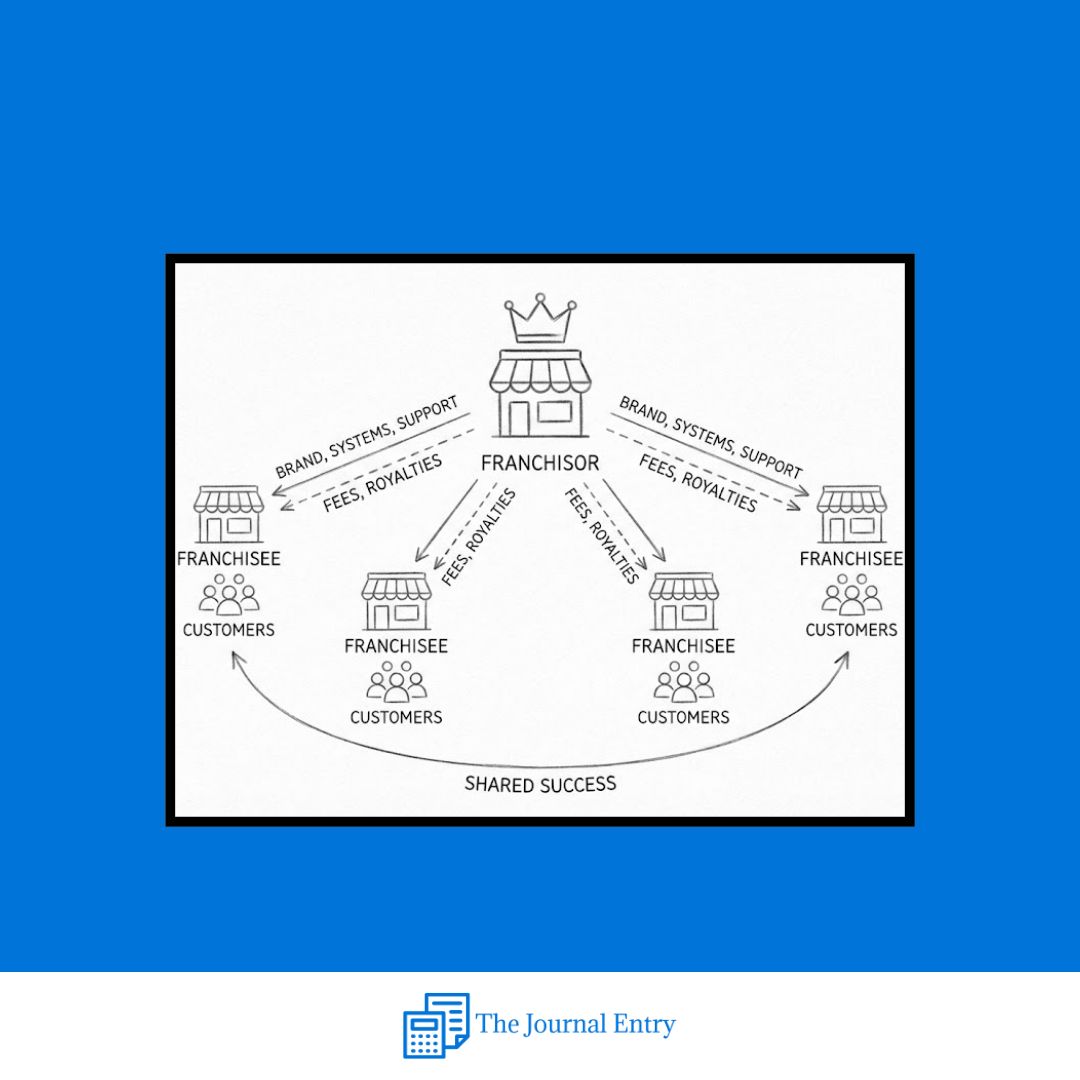
If you’ve ever wondered how the same brand shows up in every mall, every suburb, and every petrol station…
That’s franchising.
It’s one of the smartest business models because it scales fast, stays consistent, and often prints predictable cash flows.
🧠 Fun Fact:
Did you know that the word "bankrupt" literally translates to "broken bench"? It comes from the Italian phrase banca rotta. In the 16th century, Italian money-traders conducted their business on benches in public marketplaces. When a trader ran out of money or could no longer pay his debts, his bench was physically smashed to pieces to signal that he was out of business. It was the original, much more literal version of a liquidator’s notice.
What is franchising? (Simple version)
A franchise is an agreement where:
Franchisor = owns the brand + systems
Franchisee = pays to use the brand and runs the store
So the franchisor gives you the “how to run this business” playbook.
You give them money and follow the rules.
How franchisors actually make money
Franchisors earn repeatedly.
Franchise fee (once-off)
Royalties (monthly, usually % of sales)
Marketing fees
Supplier margins: many franchises earn extra by controlling approved suppliers.
Why franchising scales so well (strategy)
Growth without big capital
Franchisees fund the store setup and grow the network.
Consistency wins
Customers come back because they know what to expect in terms of quality and experience.
More stores = more trust
More locations build brand visibility which drives more sales and more franchise demand
The trap: franchises are not “guaranteed success”
A franchise is lower risk than starting from zero. But can still fail.
Common reasons for failed franchises include:
bad location
weak cost control
underestimating working capital
assuming revenue = profit
poor management
And sometimes, the franchise setup (royalties, fees, supplier barriers) also just suck…
CA(SA) lens: what to look at
Whether you’re analysing a franchisor or franchisee, focus on:
✅ Unit economics: does one store actually make money?
✅ Margins: rent + labour + stock control decide profitability
✅ Revenue quality: are royalties growing because stores are thriving?
✅ Alignment: if franchisees lose money, the brand collapses over time
The Bottom Line
Franchising is a system that turns one successful store into 100.
Franchisors earn through fees + royalties + suppliers
Franchisees get a proven blueprint but still carry execution risk
The winner is the business that standardises excellence, not the one that “just grows”
In theory it’s scalable entrepreneurship with rules and systems.
Sign Up for Trainee Contract Opportunities
For those of you working toward your CA(SA) qualification, we’ve got great news! As a subscriber to The Journal Entry, we’re doing our best to find article program opportunities for you.
Don’t miss the chance to grow your professional network and take that crucial step toward your CA(SA) designation.
Be sure to fill out the sign-up form linked below to stay informed about upcoming trainee positions!

If you enjoy our content we’d love it if you showed your friends and peers!
Please copy and paste this link to others:

Reply